
Rooted in Newark since 1851
For more than 175 years, generations of Christians have gathered at St. Mark’s to worship, pray, care for one another, serve their neighbors, and pass the faith on to those who came after them.
The buildings have changed. The people have changed. Newark has changed.
The work continues.
A Church Begins
St. Mark’s began in 1851, when a small group of Episcopalians gathered for worship in the Newark home of Esbon Blackmar on Palmyra Street, now West Union Street.
On July 22, with the bishop’s permission, they formally organized the new congregation. That August, St. Mark’s was admitted to the diocese.
They wanted a church building of their own, but they had already raised all the money they could locally.
So two women from the congregation, Mrs. A. W. Marsh and Mrs. Martha Hayes, the rector’s wife, set out to ask other Episcopal churches for help.
Carrying letters from the bishop and clergy, they spent three weeks visiting larger parishes between Newark and New York City. They returned tired but successful, bringing gifts and news that Trinity Church in New York had offered St. Mark’s a $500 loan.
A building was purchased for $350.
On September 19, 1852, the congregation held its first service there.
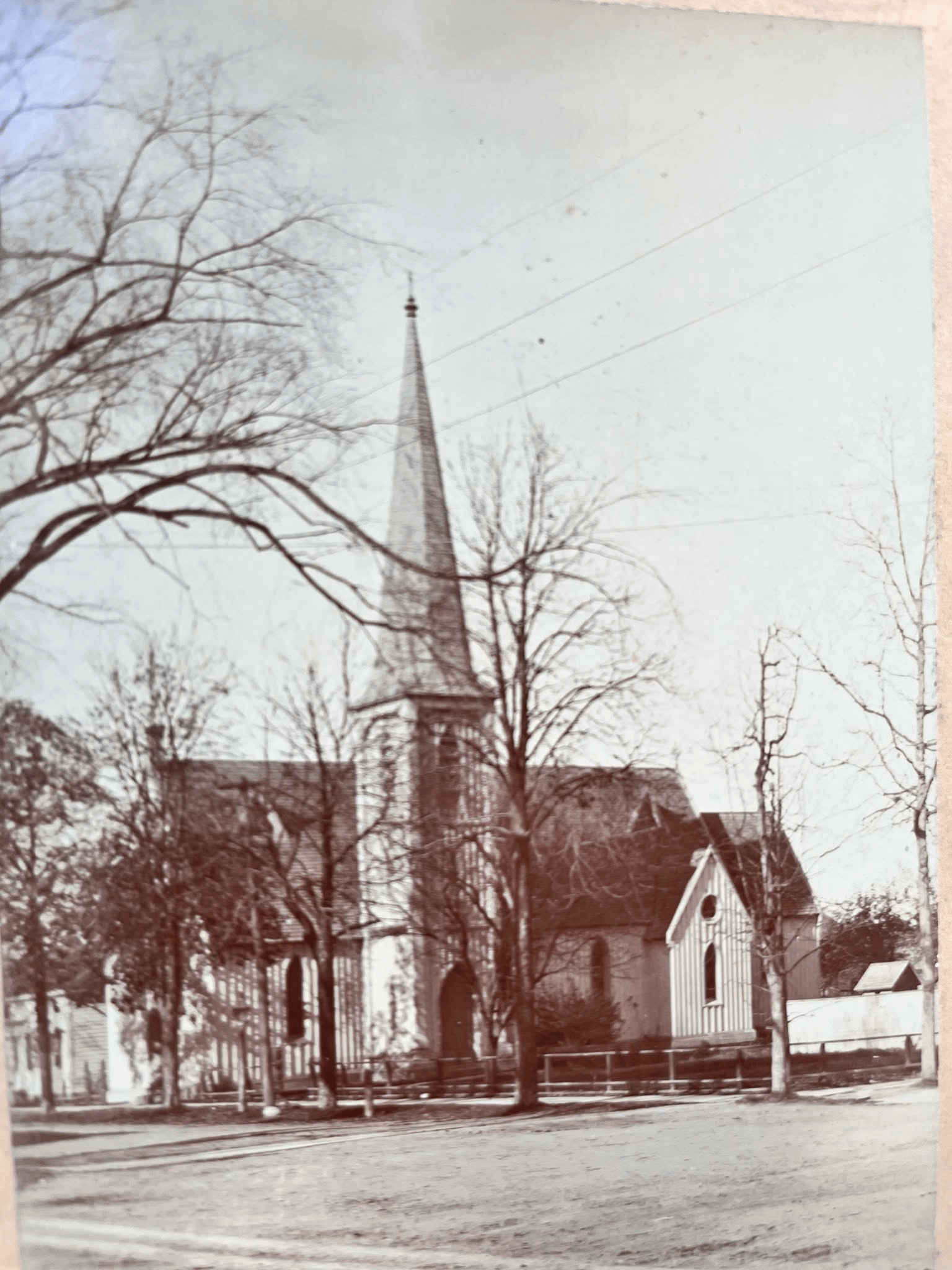
The church stood at West Miller and Main Streets and was built in the American Gothic style. It would serve St. Mark’s for the next half-century.
Built by More Than Money
The story of St. Mark’s was never only the story of clergy or wealthy benefactors.
The ladies’ sewing society helped furnish the first church, providing carpeting and an organ. Parishioners continued paying down the congregation’s debts until the church became debt-free in 1892.
That pattern has repeated throughout St. Mark’s history: people giving money when they could, but also giving work, skill, time, food, music, teaching, prayer, and whatever else the parish needed.
Most of their names are not remembered.
The church they handed on is.
A New Church for a New Century
By 1900, St. Mark’s needed more room.
The Vestry approved the sale of the first church and rectory, and on the parish’s 50th anniversary in June 1901, the cornerstone was laid for a new church.
Construction moved quickly.
On All Saints’ Day, November 1, 1901, the congregation worshipped for the first time in the new building.
That church became the heart of the St. Mark’s campus we know today.
More Than a Sunday Building
As parish life grew, St. Mark’s needed space for more than worship.
In 1917, the Bloomer families gave the parish its first parish house. There, people gathered for dinners and Christian education.
During World War II, St. Mark’s opened the parish house to the American Red Cross for relief work.
Growing Again
By the early 1950s, St. Mark’s was again planning for more space.
The parish developed plans for a larger parish hall with offices and classrooms. By 1953, much of the money had been raised.
In 1954, Bishop Dudley Stark dedicated the new parish hall adjoining the church.
That addition became much of the community, educational, office, and ministry space that extends beyond the main worship area today.
The 1954 cornerstone still marks that chapter of the building’s story.
Generations of Faith
Buildings make the history visible, but buildings are not the whole story.
For generations, people have come through these doors to be baptized and married, to worship and learn, to celebrate new life and mourn people they loved.
They taught children.
They sang.
They cooked meals.
They served neighbors.
They repaired what broke.
They gave what they could.
They disagreed, adapted, began again, and kept showing up.
What remained was the reason St. Mark’s existed in the first place: to worship God, hear the Scriptures, receive the sacraments, care for one another, and serve the community around us.
A Mission That Outlives Us
In a holiday message to the parish in 1929, Martha Thomas Comstock wrote about a life defined not by being served, but by loving, giving, and becoming a source of strength for another person in a time of need. The 2001 Courier-Gazettehistory identified that vision as still central to the mission of St. Mark’s.
Nearly a century after Comstock wrote those words, the language still fits.
St. Mark’s exists not simply to preserve a beautiful old church, but to use what we have inherited in the service of God and our neighbors.
St. Mark’s Today
History matters here.
But we are not a museum.
People still gather at St. Mark’s every Sunday to worship.
The Baby Closet provides practical help to local families.
Community groups meet in our buildings.
People learn, pray, eat together, give, serve, grieve, celebrate, and encounter Christ here.
The people who came before us left us more than stone, wood, stained glass, and memories.
They left us work to continue.
And now it is ours for a while.
About This History
This account draws primarily from St. Mark’s published parish history, itself excerpted from a May 4, 2001 article in the Newark Courier-Gazette, together with publicly available archival references. St. Mark’s historical records survive in additional parish and archival collections, and this history can be expanded as those materials are reviewed.